
- After a traumatic brain injury, Aidan used art to track his progress and reconnect with something he loves.
- At QLI, rehabilitation helped Aidan rebuild his skills and confidence while reconnecting with what makes him who he is.
- Now, his superhero artwork reflects the strength, determination, and recovery that will take him home to Tennessee.
A row of easels sat front and center in QLI’s Lied Life Center. Each held a piece of art created by 20-year-old Aidan Dwyer, with each canvas telling a little more of the story behind his rehabilitation. Dozens of popular superheroes were on display not just for their bright colors, but for what they represented to Aidan.
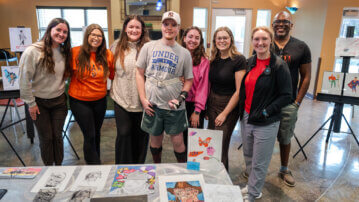
Before a traumatic brain injury changed his life, Aidan was a college student who loved playing baseball, spent time fishing, and grew up about 40 miles outside Nashville with a family he describes as one of his biggest sources of support. Now, standing among his artwork in a show he organized, Aidan had something else to show off: how far he had come.
The First Drawing Told a Different Story
The first picture Aidan attempted to draw after the car accident that caused his traumatic brain injury looked much different. In those early days at Shirley Ryan Ability Lab in Chicago, Illinois, his first therapists assisted an unsteady hand as it drew red swirls and lines, reflecting his decreased control. Through the weeks ahead, he kept drawing.
The Next Phase
Aidan first arrived at QLI in the middle of summer. He was seen navigating campus with a power chair, quickly transitioning to a manual wheelchair. “He just caught on to things quickly. He never wanted to take a rest break,” Andrea Zanavich, his physical therapist, said. “He’s just been self-motivated the entire time.”
Just weeks later, he parked the chair and transitioned to his own two feet, with the help of a walker.
Through QLI’s LifePath program, Emma Shaw helps clients reconnect with the passions that make them who they are, giving them the dignity, autonomy, and support to rebuild a life that feels like their own. She also saw that determination throughout Aidan’s time at QLI. “Not once did I ever hear him complain or give me a reason why he couldn’t do something,” she said. “It was always, ‘Let’s figure this out.’”
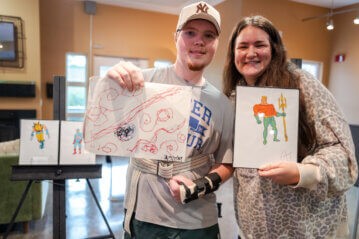
Art became a way to help Aidan reconnect with something that made him feel like himself, a passion he has held since the age of four. But it was about more than being able to control a pencil again. “[Drawing] made me think,” Aidan described.
One of Aidan’s last pieces of art at QLI is Wolverine, one of his favorites because the lines are clean and sharp. When Dr. Jeff Snell, neuropsychologist at QLI, compared Aidan’s first drawing with one of his latest pieces, he saw more than improved artwork. Jeff explained it is “a dramatic recovery of the motor ability, coupled with higher cortical functions of planning, creativity, and multiple executive functions.”
The Show
On the day of his art show, he had only a cane in tow for physical support and his family for emotional support.
When asked what his superpower is, he doesn’t hesitate. “Strength,” Aidan said with a smile.
Categories: Art Therapy, Brain Injury, Client Story, Neuroplasticity, Rehabilitation